Wordle

Friday, August 29, 2008


I uploaded a rough draft of a paper I'm writing for my cognitive modeling class to Wordle, and this is what I got. Wordle's a pretty nifty tool for making pretty word pictures.

My Arabic thesis below:

How To: Create a ConTact Paper Wall Decal

Wednesday, August 20, 2008


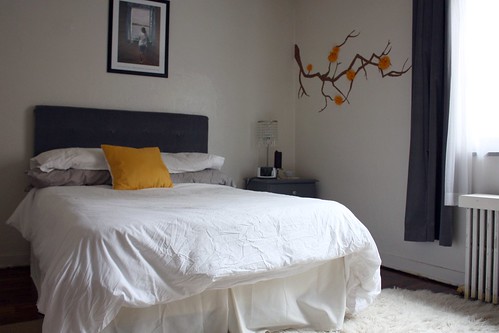
A How-To for the much mentioned ConTact Paper Wall Decal. This one is a graphic tree branch going up above my bed.

Step 0: Materials


  • ConTact Paper (Self adhesive)
  • Scissors
  • Writing Utensil

Step 1: Draw Your Desired Base Image


Draw the desired "base image" (your end picture, minus all the details) on the back of the ConTact paper. Remember the drawing will be mirrored on the wall.

Step 2: Cut Out Your Base Image


Step 3: Draw Details on ConTact Paper


Once you've created a base image, you can now draw smaller details to add to it. Remember your drawing will be mirrored once placed on the wall.


Step 4: Cut Out Details


Step 5: Place Details on Base Image, for an idea


Once I've completed cutting out all my main parts, I like to place/layer the pieces, so I know how to place them on the wall. If you wish, you can photograph your work at this stage for some extra help.

Step 6: Peel a Small Edge of Your Base Image


Now it's time to peel a small edge of your base image. Don't peel too much of the paper backing off of the ConTact vinyl, or the sticky sides will start sticking to each other!

Step 7: Place Small Edge On Wall


Place the sticky-backed vinyl onto the wall in your desired location. Sometimes I use small pieces of Scotch tape to approximate the location of longer base images. Remember, it's important to only peel and place a small piece at a time.

Step 8: Rub Edge Onto Wall


It's important that you rub the edge of the adhesive-backed ConTact vinyl pretty vigorously in order to secure it to the wall. Some people suggest using the edge of a credit card for this stage, but I find that credit cards can scratch the vinyl surface.

Step 9: Peel a Little More, Place a Little More, Rub a Little More


Continue doing steps 6-8, peeling a little further, placing, and then vigorously rubbing the vinyl until there is nothing left to secure.


Step 10: Follow steps 6-9 for the Detail Pieces


Step 11: Create and Add Accent Pieces


In this example, my 'accent pieces' are little blue ConTact circles added to the empty branch. Feel free to add whatever you wish, or maybe nothing at all!

[Edit 10/1/2009: Bedroom redecorating required a new accent, Felt Flowers. Read how to make them, here.]
Bedroom, from SE corner

1001fonts.com

Sunday, August 17, 2008


I've only played around with 1001fonts.com a little bit, but it appears to be rather handy for making some simple logos and headers, like the examples above (shown: Waltograph, Cocaine Sans, Electroharmonix).

Font Install Notes For Windows Vista Users


BYOV takes no responsibility for any effects of following these directions. They worked for me, but maybe not for everyone.
  1. Download and unzip the font from 1001fonts.com.
  2. Locate the 'Fonts' folder by going into your 'Control Panel' via the Start menu.
    • If in 'Control Panel Home' select 'Appearance and Personalization', and then 'Fonts'.
    • If in 'Classic View' select the 'Fonts' folder.
  3. Locate the 'true type font' file (file extension is .ttf) where you downloaded it and then copy and paste it into the 'Fonts' folder.
  4. Windows Vista may ask your permission to perform the operation, be sure to permit it.
  5. The new font is now usable/viewable in applications such as Microsoft Word.

Techy Russian Nesting Dolls

Thursday, August 14, 2008

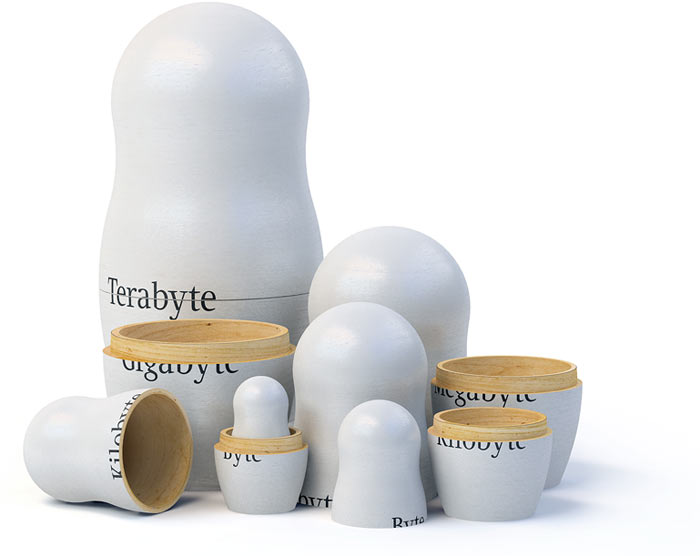
From artlebedev

These Techy Russian Nesting Dolls are utterly ridiculous (in a good way), but $42 worth?

Printing Fabric

Photo from Jezze's blog

Jezze has a post on her blog about printing fabric using lino blocks. She sells her prints for a considerable sum of money at her Etsy Shop. They're really cute and would make awesome pillows, if I didn't already have a million pillows.

Other resources:

Last Item

Wednesday, August 13, 2008

Living Room, sofa

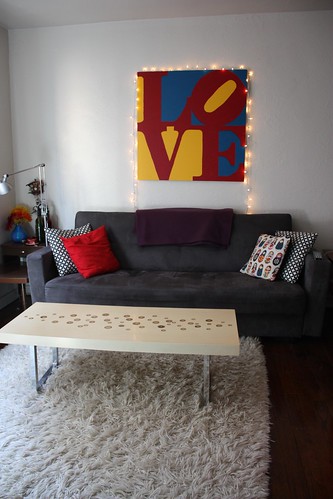
So, the last item of furniture I need for my new apartment was delivered today. A microfiber ratchet bed in charcoal with scotchguarding from Mealey's. It's sleek, it's modern looking, it's decently comfortable, and it can hold overnight guests. Now I'm ready to haul all this furniture six hours west on Friday.

How To: Make Pillow Covers with Welt Cording

Monday, August 11, 2008


I had difficulty finding a tutorial for making pillows with welt cording, so when I made mine I snapped a few photos. This project is probably best for advanced beginner sewers and beyond.

What is Welting?


Welting is a sort of cord that is sewn into upholstered couches. In this tutorial I use a premade cord-welting that I got at JoAnn Fabrics, but you can also make your own (google 'how to make welt cording').

Step 0: Materials


  • Enough decorative fabric to cover the front of your pillow form
  • Enough decorative fabric to cover the back of your pillow in width, plus extra for the length (approximately 1.5 times as long). See Step 1.
  • Enough welt cording to cover the perimeter of your pillow, plus a few inches extra
  • Thread, sewing machine, pins, scissors, etc.

I used Urban Outfitter's Matryoshka Tapestry for the decorative fabric and black kona cotton from JoAnn Fabrics for the backing.

Step 1: Cut the fabric for your pillow


I am making a pillow cover for a pillow form that is 16"x16". My welt-cording has a 1/2" ribbon for attaching, therefore I assume a 1/2" turning-corner-allowance as well as seams/hems. If your welt cording has a different size flat ribbon, then your hem allowances may need to be adjusted. So, I need a front (decorative) square with 1/2" seam allowances on all sides and two back panel pieces (to form a simple flap closure). The back panel pieces need an additional 1/2" hem allowance where they will overlap.

Above, a flap closure


Step 2: Sew the doubled-over half inch hem on a wide edge of each of the backing fabrics.


Step 3: Layer and pin fabric, welt cording, and backing


You want to layer the three layers like the above, making sure that the decorative fabric and the backing fabric have right sides facing together. The rope-welt should be facing inwards into the center of the pillow, allowing the flat edge of the welt cording to line up with the edges of the backing and front. Do not start at the corner of the pillow with the cording!!

Pinning small sections at a time are a good idea. Additionally, when approaching a corner, remember to cut a line in the cord welting *fabric* (not the rope!), a half an inch before the corner, as shown below.


Step 4: Continue pinning the layers around the three outer edges of the backing fabric.


Step 5: Sew through three layers (first backing flap)


Sew the three sides of the backing fabric (as pinned), starting right after the cord. You need to sew as close to the welting cord as possible, to do this, I remove the foot on my sewing machine, like below.

Step 6: Layer second backing piece at opposite end


Layer the welt cording and second backing piece onto the decorative front, right sides facing, just like the first backing piece. Where the second backing piece overlaps the first, ensure that the welt cording is under both layers of backing, like below.

Step 7: Finish Pinning the Second Backing and Welt Cording


Continue pinning the two layers of fabric with right sides facing and welt cording in the middle. When you approach the beginning of the cord, cross your working end over the beginning end, making a sort of 2 inch "X" outside of the fabric, like below:

Step 8: Sew the three sides of the second backing flap, as pinned


Be sure to sew over the first backing flap, as necessary. When you reach where the two cords cross over each other, skip it (or stop, depending on how you started your welt cording).

Step 9: Cut off corners


Cut off the fabric at the four corners of the pillow at an approximately 45 degree angle. This ensures a cleaner corner.

Step 10: Cut off and Secure Welt Cording


Cut off the remaining welt cording, leaving a 2 or 3 inch remainder. Be sure to secure the crossing of the welt cordings by hand-sewing.

Step 11: Turn Right Side Out and Fill With Pillow

Living Room, sofa

With a little finagling, you can get your pillow form into the flap closure, and place it on a couch.

Label Cloud for Blogger

Sunday, August 10, 2008


Rather than a plain list of labels/tags/whatevers that Blogger default provides, you can add a "label cloud" to your blogger which shows the popularity of the label by a growing font size. I added a label cloud to this blog by following the directions at phydeaux3.

Pittsburgh Apartment

Saturday, August 2, 2008


There's been a slow evolution in the plans for my living room in my new apartment as seen in the MSpaint/Photoshop models above. My last apartment had a living room, but I owned very little of the furniture, so I get to start from scratch. I think I'm finally content with this layout and color combination.

Living Room Items of Note:
[Edit 12/3/09: Check out the dimensions, with the furniture, at a new post, here.]

Bird Decal Progress


We're making some slow progress here, but so far so good. The ConTact paper is working great!! You can't see where the different pieces touch unless your nose is 6 inches from the wall. However, if you reposition the ConTact paper too many times, it loses its stickiness.

This method is blogged about here.